MPI Mouse-Bed Insert
A custom removable insert that positions magnetic nanoparticle-filled capillaries at fixed, repeatable locations inside an MPI mouse bed for accurate image registration.
Undergraduate Research Assistant, Rinaldi-Ramos Laboratory
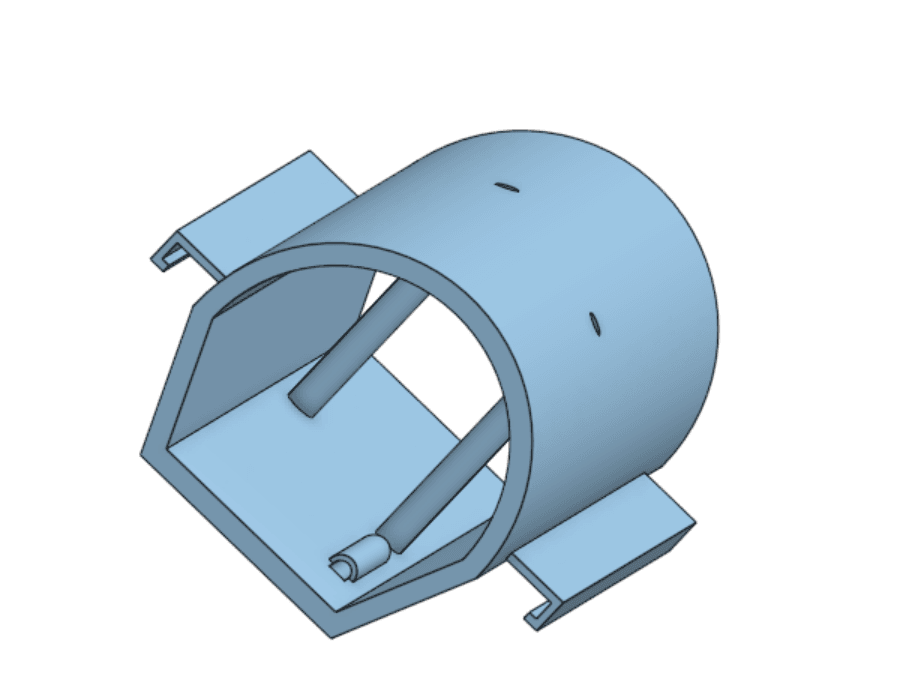
Overview
As an undergraduate research assistant in the Rinaldi-Ramos Laboratory, I design a custom mouse-bed insert for Magnetic Particle Imaging (MPI) research. The insert holds magnetic nanoparticle-filled capillary fiducials at fixed, repeatable locations inside the lab's existing mouse bed, standardizing sample placement between scans.
Problem
MPI research depends on comparing images across scans and subjects. Without a fixed, repeatable way to position calibration capillaries inside the mouse bed, sample placement varies from scan to scan, which makes accurate image registration and overlay difficult.
Goal
Design a removable insert that fits the lab's existing MPI mouse bed and holds capillary fiducials at controlled spacing, position, and orientation, so imaging results can be reliably registered and compared across scans.
Constraints
- Must fit inside the existing MPI mouse bed without modifying it
- Must position capillaries with repeatable spacing, position, and orientation
- Must be manufacturable with in-lab resin 3D printing
- Must not interfere with imaging or scanner operation
Design Process
- Modeled early insert concepts in SolidWorks to establish capillary spacing and mounting geometry
- Refined the design into a dedicated insert shell and capillary insert that seat cleanly inside the mouse bed
- Iterated to a version 2 insert and bed geometry, printed and tested on a Formlabs resin printer
- Prepared imaging phantoms by filling capillary tubes with iron oxide magnetic nanoparticle solutions for calibration and testing
Build / Fabrication
Parts were modeled in SolidWorks and 3D printed in resin on a Formlabs printer, including print preparation, support removal, cleaning, and UV curing of each component.
Testing
I operate the MPI system under supervision, assisting with scanner setup, sample positioning, image acquisition, and experimental testing, and assist researchers with mouse imaging experiments including equipment preparation and subject positioning.
What I Learned
This project connected mechanical design directly to the reliability of a research dataset. Small differences in capillary position or orientation carry through to image registration, which reinforced how much of research-grade hardware design is about repeatability, not just function.